The Walnuts That Explained the Collection
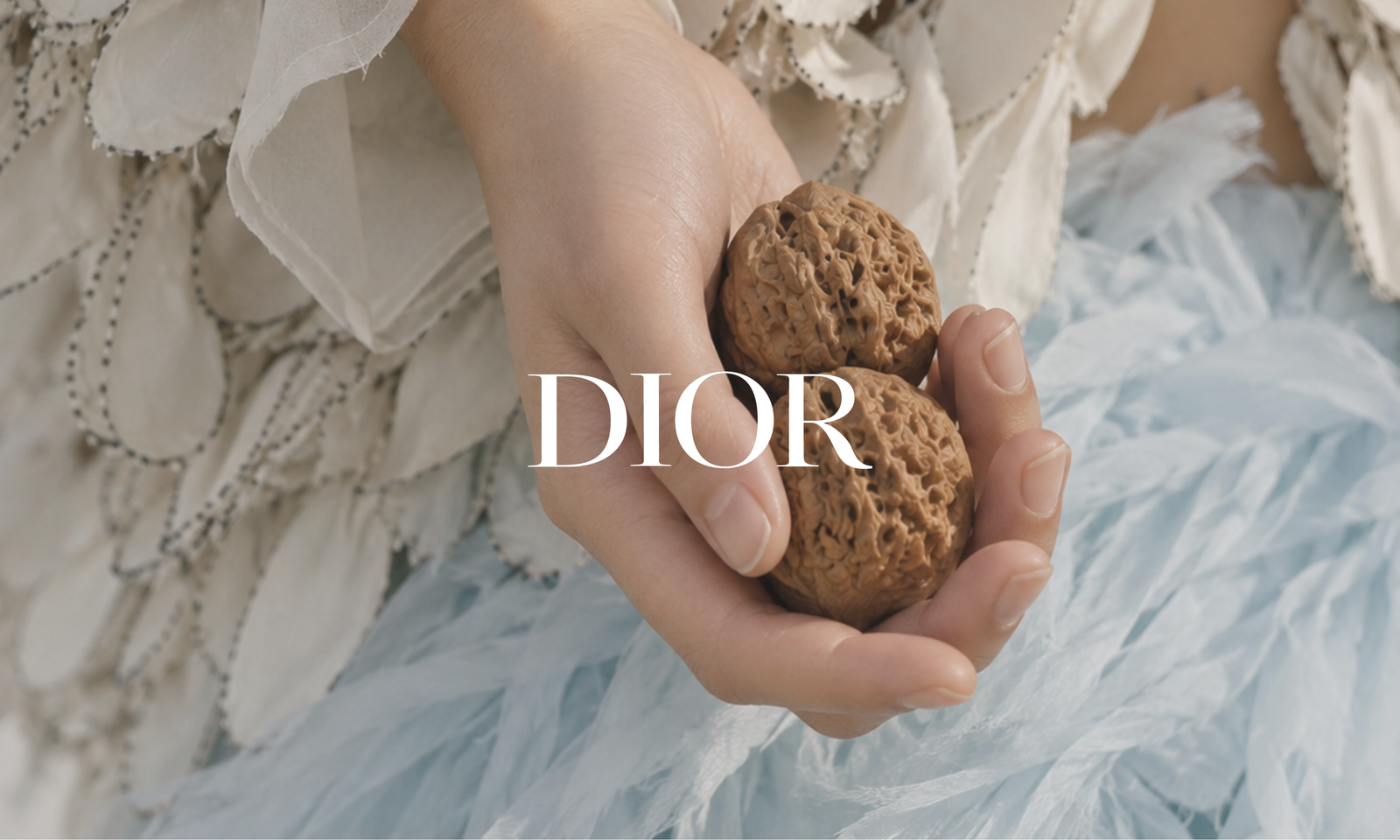
The invitation to the Dior Spring/Summer 2027 ready-to-wear show contained a pair of wénwán walnuts. In a longstanding Chinese tradition, the walnuts are slowly rotated in one hand. Through repeated touch, their rough shells gradually become smoother and develop an amber-coloured shine. The practice is associated with longevity and good fortune. Anderson said the walnuts reminded him that knowledge and preciousness can be found in nature.
The idea offered a key to understanding the collection. The beauty of these objects is not immediate. It develops through touch, patience and time. Fine pleats opened into generous volumes. Tailored pieces ended in long, loose fringes. Small fabric shapes were layered together to resemble petals, scales and plumage. Dresses appeared light and spontaneous, even when their carefully controlled forms revealed complex construction underneath.
Anderson also returned to some of Dior’s most recognisable shapes, changing their proportions and making them feel less formal. The rounded hips of the New Look became softer. The Bar jacket was relaxed and wrapped around the body. Flowers were not simply printed onto dresses. Instead, garments were folded, layered and shaped to behave like flowers.
Nature, Built Into the Clothes - Look 05
The jacket is covered in hundreds of overlapping cream shapes, each edged with a fine dark trim. From a distance they could be petals, feathers or even butterfly wings. The pale-blue mini skirt continues the idea, but in a much softer way, with loose strips that flutter around the hips as the model walks.
The interesting part is how Anderson turns texture into the decoration itself. Nothing feels perfectly uniform or controlled. Like the wénwán walnuts that inspired the collection, the beauty comes from repetition, irregularity and surfaces that feel almost shaped by nature.

Dior’s Archive, Made Lighter - Look 10
At first, the dress feels almost weightless. Two fine shoulder straps hold a softly pleated bodice, gathered at the centre with a small knot. The shape stays narrow through the body before opening suddenly at the hips into a full, floating skirt, almost like a flower beginning to bloom.
The silhouette recalls Christian Dior’s La Cigale dress from Autumn/Winter 1952, known for its exaggerated hips and sculptural construction in heavy grey moiré. Anderson keeps that same sense of volume, but makes it feel much lighter. The structure is still there, only softened through pleating and movement rather than stiffness.

When Lightness Becomes Structure - Look 47
From the front, the checked jacket looks almost like a traditional winter coat, with the familiar weight and structure of classic tailoring. But from behind, that impression changes. The fabric falls much more softly than expected, ending in two long, almost transparent fabrics that move freely behind the body.
The skirt plays with the same contrast. Each individual layer appears extremely light, but hundreds of fine pleats are built up together to create something dense and sculptural.
It is a nice contradiction: materials that look delicate and weightless, constructed until they begin to feel substantial.

Lace Breaking Through - Look 53
From the front, the checked jacket looks almost like a traditional winter coat, with the familiar weight and structure of classic tailoring. But from behind, that impression changes. The fabric falls much more softly than expected, ending in two long, almost transparent fabrics that move freely behind the body.
The skirt plays with the same contrast. Each individual layer appears extremely light, but hundreds of fine pleats are built up together to create something dense and sculptural.
It is a nice contradiction: materials that look delicate and weightless, constructed until they begin to feel substantial.

Beauty in Erosion - Look 52
This look feels almost like fabric being slowly eaten away. A soft yellow base is interrupted by black lace, while irregular pieces of fabric sit over the surface like torn petals or leaves. The one-shoulder shape makes it feel even less controlled, as if the dress has been built up organically rather than cut into a perfect form.
The contrast is what makes it interesting: something delicate and decorative, but also slightly raw. Again, Anderson makes nature feel less like a motif and more like a process.

A Softer Side of Dior
Across the collection, Anderson keeps returning to the same idea: beauty does not always come from perfection or immediacy. It can come from repetition, ageing, touch and the way materials change over time.
That is what makes the wénwán walnuts such a fitting starting point. Like the objects themselves, many of these clothes become more interesting the longer you look at them. Pleats build into volume, lace appears to erode smooth fabric, and familiar Dior shapes are softened until they feel almost organic. The house codes are still there. They have simply been allowed to loosen, move and evolve.


