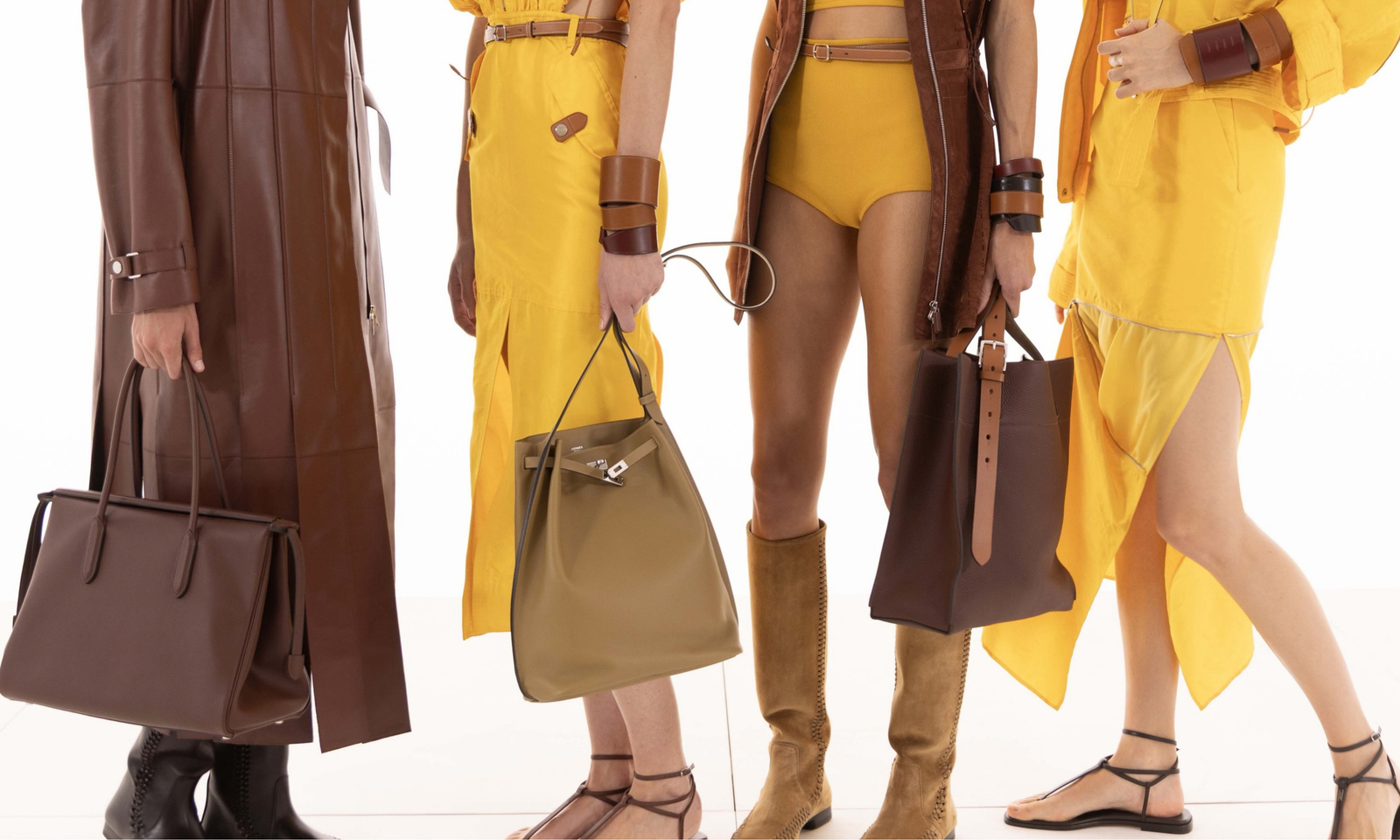
The Hermes Spring Summer 2027 may have been built around the theme of air and movement, but for many Hermès collectors, the first question after a new runway remains the same: what about the bags?
This season, the answer is particularly interesting. Hermès introduced new shapes, revisited familiar designs and pushed some of its best-known bags in unexpected directions.
Seen up close, the collection becomes less about one standout “It bag” and more about the details: how a closure works, how a bag is constructed, how different materials are combined, and how Hermès continues to reinterpret shapes that have existed for decades.
A New Take on the Hermès Toolbox
One of the biggest surprises of Spring/Summer 2027 is the return of the Hermès Toolbox.
First introduced in 2010, the original Toolbox is recognisable for its structured shape, wide opening and two rounded top handles. The new version keeps some of that familiar architecture but strips the design back considerably.
The two top handles have been replaced by a single tubular handle attached with metal rings, while a longer strap offers the option of carrying the bag on the shoulder. The closure has also been redesigned, with a rectangular metal plate replacing the hardware associated with the earlier Toolbox.
That approach appears throughout the collection. Rather than reproducing past designs exactly as they were, Hermès keeps enough of the original DNA for collectors to recognise the reference, while changing the proportions, hardware or way the bag is carried.
For anyone who remembers the original Toolbox, this may be one of the season’s most interesting revivals.

When Hermès Gets Playful
Some of the most memorable pieces are not new designs at all. One of the standouts at the re-see was a white Kelly in smooth Box calf, decorated with colourful flowers created through embroidery and tiny beads.
From a distance, the decoration looks drawn onto the bag. Up close, individual beads rise from the surface of the leather, giving the flowers texture and dimension. There is something slightly storybook-like about it, almost as if the floral border of an illustrated children’s book has been transferred onto a Kelly.
The choice of leather makes the contrast even more noticeable. Box calf is smooth, polished and quite formal. Against that clean white surface, the colourful flowers feel unexpectedly playful.

Le Petit Sac
Then there are the bags that are simply fun. The small Le Petit Sac returned in a bright yellow version covered with embroidered blueberries.
What makes the design interesting is not simply the fruit motif, but the way the blueberries have been made. Rather than sitting flat against the leather like a print, the embroidery gives each berry a rounded, almost three-dimensional surface. From a distance it looks playful. Up close, you start to notice how carefully each small detail has been constructed.
It is something Hermès does particularly well. A motif can be almost childlike, while the execution remains extremely serious. The decoration may be light-hearted, but the craftsmanship underneath it remains unchanged.

Garden Party
The Garden Party moves in the opposite direction. Rather than adding decoration, Hermès has made the bag more practical. An oversized exterior pocket wraps around the body, giving one of the house’s simplest totes an almost workwear-inspired feel. It is still immediately recognisable as a Garden Party, but the added storage changes the character of the bag completely.
One is about decoration. The other is about function. Both show how Hermès can change the personality of a familiar design without losing what made it recognisable in the first place.

The HAC 40
The Haut à Courroies, better known as the HAC, is one of the most fascinating bags of the season.
The traditional HAC sits inside an additional leather structure. Thick horizontal leather bands wrap around the sides, while a large padded panel covers much of the front. The top and lower edges are finished with prominent leather lacing, and contrasting stitching draws attention to almost every part of the construction.
It is a lot of leather — and visually, that is part of the point. Instead of trying to make the technique disappear, Hermès puts the way the bag is made on display.
The saddle stitching is particularly relevant here. Unlike a standard machine seam, traditional saddle stitching is worked by hand using two needles passing through the same holes from opposite directions. This creates a particularly strong seam; if one stitch becomes damaged, the entire line does not immediately unravel.

The Mini Bolide Picnic
Another highlight is the return of the Bolide Picnic.
The Bolide itself has an important place in Hermès history. Introduced in the early twentieth century for the growing world of automobile travel, it became closely associated with the zip closure — at the time, an unusually modern piece of hardware for a handbag.
Which makes this version particularly interesting, because the Bolide Picnic has no zip at all. Instead, the bag has a rounded woven wicker body topped with smooth leather. The handles, upper structure and trim retain the familiar language of a Bolide, but the opening has been simplified to just one narrow leather strap secured by a button.
The craftsmanship, however, is anything but simple. You can clearly see the different materials and the different techniques. Even the leather lacing around the curved upper edge becomes part of the design. There is something very Hermès about that.

The Rênes
The Rênes is one of the cleanest new shapes of the season. Rather than relying on a flap, turn-lock or visible metal closure, the bag is almost entirely hardware-free. Its soft calfskin body is shaped into a structured trapezoid, with long leather handles attached directly to the front and back. Leather cords at the sides control the opening, releasing the top when pulled apart.
It is a very different expression of Hermès from the highly detailed HAC or embroidered Kelly. Here, the interest comes from proportion and construction rather than decoration.
Shown in several sizes and colours including Black, Gold, White and red, it may also be one of the most wearable new designs from the season.

The Kelly Hobo
The Kelly Hobo returns for Spring/Summer 2027 after first appearing in the Spring/Summer 2026 collection as a modern interpretation of the Jean Paul Gaultier-era So Kelly.
The familiar Kelly sangle remains, but the bag itself is much softer and more relaxed than a traditional Kelly. Most notably, the shoulder strap is integrated directly into the body rather than attached with the metal rings seen on the original So Kelly, creating a cleaner line from bag to strap.

The Petit Belle Île
The Petit Belle Île takes a bag previously seen in the men’s Spring/Summer 2026 collection and scales it down for SS27.
Its smaller proportions make the design feel noticeably more refined, but most of the original details remain: a canvas body, sturdy leather base, wide shoulder strap and the large ring attachment that recalls the Arçon. A key clochette hangs from the ring, while the Hermès padlock is suspended from a slim leather tab at the front.

A Season of Familiar Shapes and New Ideas
What makes Hermès Spring/Summer 2027 interesting is not one single bag, but the way the house continues to experiment without making the experimentation feel obvious.
Many of the strongest ideas only reveal themselves up close: a different closure, an unexpected material, a new proportion, or a familiar shape handled in a completely different way.
That subtlety is very Hermès. The house rarely needs to reinvent everything at once. Sometimes the smallest change is enough to make a bag feel completely new.
For collectors, that may be the most interesting part of the season — seeing which of these ideas remain one-off experiments, and which eventually become part of the Hermès vocabulary for years to come.


