Fall 2026 Haute Couture — Musée Rodin, Paris
The invitation was a fan, and that turned out to be the whole idea. On July 6, Jonathan Anderson filled the mirrored halls of the Musée Rodin with palm leaves and foliage for a collection where fabric was folded, knotted and coaxed into sculpture. Sabrina Carpenter, Parker Posey and more attended the show. On the runway, gowns crinkled and folded back on themselves, their metallic fabric catching the light like liquid metal.
This is Anderson's second couture outing for the house, and his muse this season is a woman who spent a career refusing to sit still: the American sculptor Lynda Benglis.
Where the inspiration comes from
Benglis, now 84, made her name in 1968 by doing something almost scandalously simple — she poured pigmented latex straight onto her studio floor and let it harden into shape. Trained as a painter in the shadow of Jackson Pollock, she freed color from the canvas and let it puddle, drip, and stand on its own. By the early 1970s she was tying wire mesh, plaster, and cotton into great metallic knots, spraying them with aluminum, copper, and zinc until they gleamed like something between a seashell and a machine.
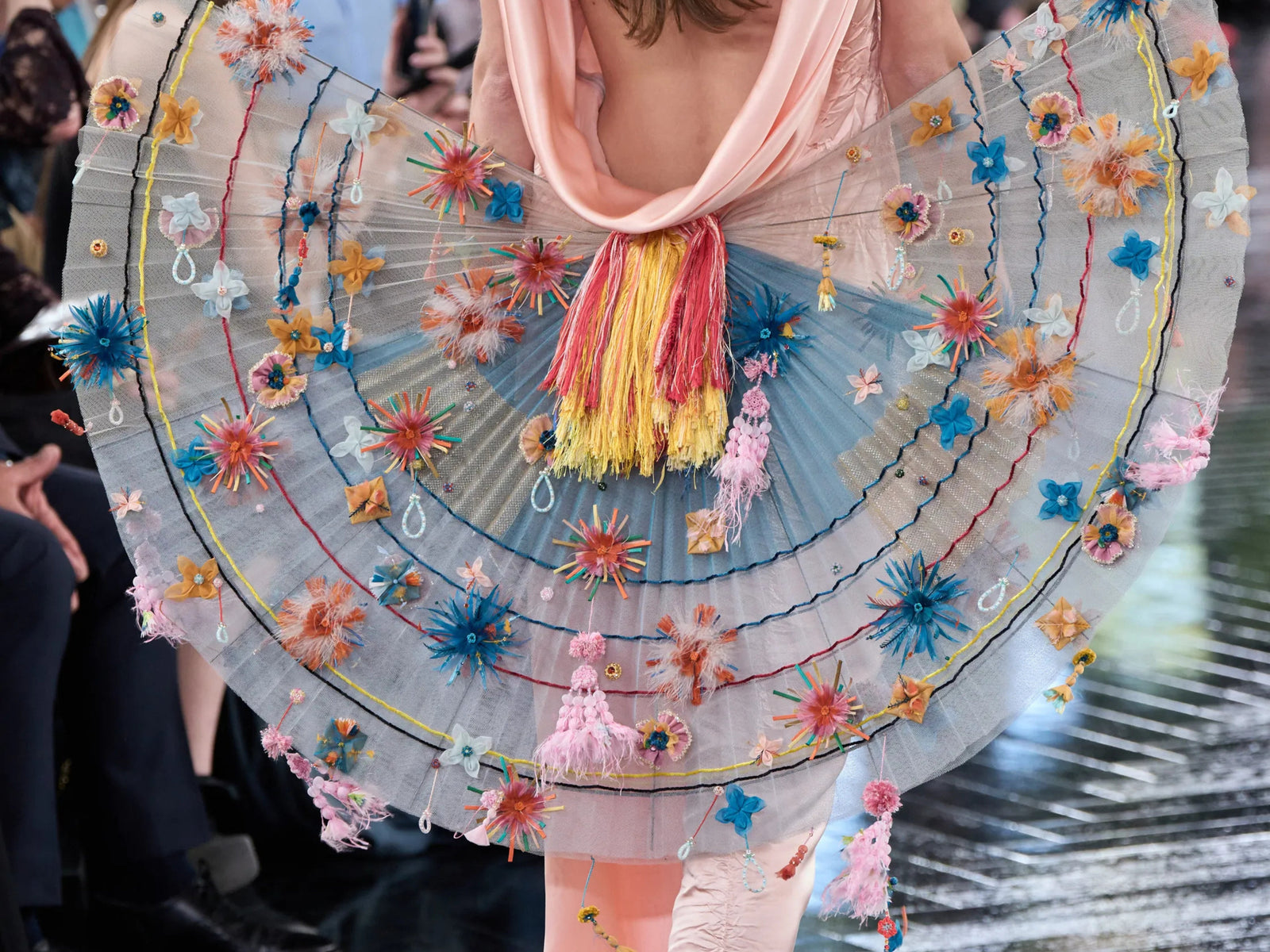
Anderson translated that vocabulary almost line for line. Her wire-mesh pleating became hand-plissé couture; her knots reappeared as bows twisting through gowns and handbags; her metallic sheen turned up in iridescent tweeds and sculpted, crinkled silk. The show's 24th and 30th looks feature a vast embellished fan that is essentially a wearable copy of Benglis's Zanzidae, From the Peacock Series (1979). Dior even unveiled four new bags co-designed with the artist — including a metallic Cigale and a new sculptural Bow bag.


A house that has always loved artists
Benglis is the headline, but she isn't the only artist in the room. Look after look felt like paintings being brought to life.

A fringed white gown with a sweeping train recalled the shimmering bride of Gustav Klimt's Portrait of Margaret Stonborough-Wittgenstein (1905).

A red pleated cape echoed the clean, deliberate slashes of Lucio Fontana's Spatial Concept, Waiting (1966).

A dark ribbed knit over a skirt of torn, layered metallics lifted straight from Benglis's own Georgia On My Mind (2018).
This is Dior in its natural habitat — Christian Dior ran an art gallery before he ran a fashion house — and Anderson, the first designer since Monsieur Dior himself to oversee every line, treats the runway as a place where fashion and art quietly trade clothes. His debut couture last season borrowed the curving silhouettes of ceramic artist Magdalene Odundo; this one turns an entire collection into a walk through a gallery.
The result, critics agreed, was confident and refreshingly original — a debut-era Dior that treats a fold of fabric xx as something close to sculpture, and art history as exactly the right kind of muse.


