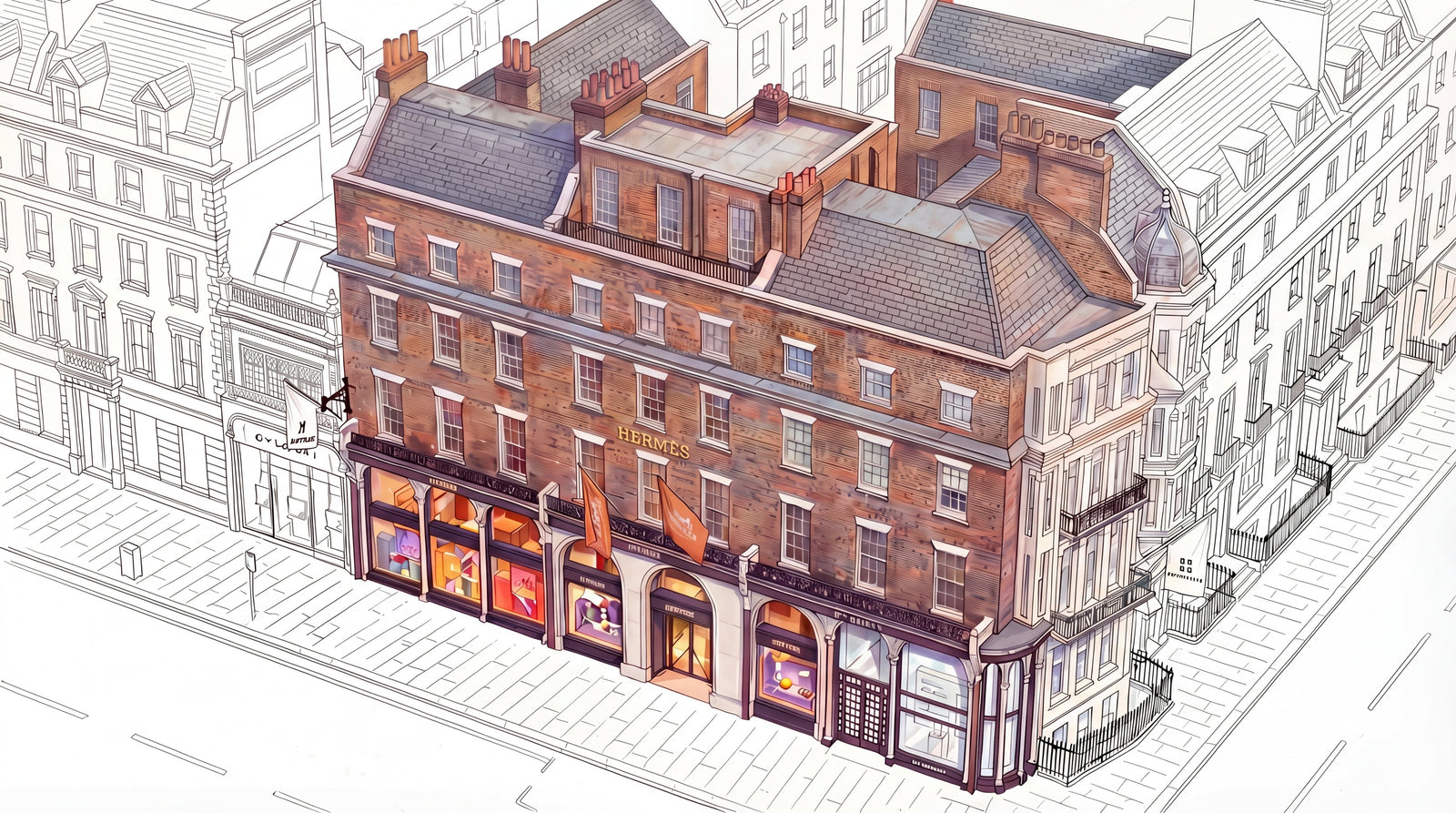
In 1847, the luxury house Asprey moved into 166 Bond Street. Over the next 150 years, it gradually expanded into the neighbouring Georgian townhouses, creating one of the most distinctive retail locations in London.
By the early 2000s, the store had been significantly redesigned by architect Norman Foster. At this point, it had become a large luxury retail space of more than 20,000 square feet, and one of the most valuable properties on the street.
At a Glance
- Opening
- 16 June 2026
- Address
- 166 New Bond Street, London W1S 2EL
- Purchased by Hermès
- 2009 for £73 million
In 2005, Asprey sold the freehold to an Irish property company called Quinlan Private. This was part of a sale-and-leaseback deal, which meant Asprey received cash but stayed in the building as a tenant.
In 2009, Hermès bought the freehold for £73 million. At the time, this was one of the highest prices ever paid for a property on New Bond Street.
After this, very little changed for many years.
Hermès continued to operate from its nearby flagship at 155 New Bond Street, which it had used since 1975. This store was beautiful but relatively small, and it limited how the brand could present all of its product categories.
At the same time, Hermès quietly planned what to do with the new site.
Asprey's Legacy
William Asprey founded the business in 1781. The family traced its roots to Huguenot silversmiths who fled France in the 1680s. From its original home at 166, the shop absorbed every neighbouring property — eventually stretching across 165 to 169 New Bond Street, 22 and 23 Albemarle Street, and 16 Grafton Street. The iconic shopfront with its barley-twist columns dates from 1865 and was so admired that the design was copied across the other frontages along the street.
The Building's Famous Residents
Sir Henry Irving — the first actor ever to be knighted — lived on the upper floors of 165 New Bond Street from 1872 to 1899. His quarters were described as "a perfect example of the confusion and neglect of order in which the artistic mind delights." A blue plaque commemorates him, though nothing of his interior survives.
A Building That Is Several Buildings
Part of what makes 166 so significant is that it's not just one building, and different from anything Hermès has done in London before.
Most of these properties date from the early 1720s. Because they were built at different times and later joined together, the interiors are uneven — different floor levels, varied ceiling heights, constant changes in layout. This made the renovation complex, but also gave it character.
Nine Staircases and a Planning Battle
The site contains nine separate staircases, and they became the most contentious part of the planning process. Hermès originally proposed removing the "White Stair" at 165 New Bond Street. Historic England objected three times, and Hermès ultimately had to keep it.
The "Blue Stair" at 166 is a 1770s circular spiral made from Baltic pine — still standing after 250 years, though now sagging and worn. It has been agreed that Hermès will conserve and strengthen it rather than replace it.
The most important survival on the site is the cantilevered stone staircase at 16 Grafton Street, designed by Sir Robert Taylor in the 1770s. It rises the full height of the building with scrolled wrought iron balusters and a barrel vault.
There is also a 1920s Art Deco lift at 22 Albemarle Street with ornate metal screens on each floor. It hasn't run in years, but Hermès will be bringing it back to life.
Why This Building, Why Now
Hermès did not need another store in London. What it needed was the right building in the right location at the right time.
166 New Bond Street offers something rare. Its many rooms, multiple levels, and rooftop space create a sense of discovery. A modern building would not feel the same.
On 16 June 2026, the new store will open.
FAQs
The building was previously home to luxury goods house Asprey, who moved to 166 Bond Street in 1847 and eventually expanded across a connected run of Georgian townhouses. Asprey commissioned Norman Foster to redesign the interior in the early 2000s. In 2005, they sold the freehold to Irish property group Quinlan Private in a sale-and-leaseback deal. Hermès then purchased the freehold in 2009 for £73 million.
Hermès paid £73 million for the freehold in 2009 - at the time one of the highest prices ever paid for a property on New Bond Street.
The interior was designed by RDAI in Paris under Denis Montel, Hermès' longtime architectural partner.
The new maison is an interconnected cluster of Georgian townhouses spanning 165 to 169 New Bond Street, 22 and 23 Albemarle Street, and 16 Grafton Street - most dating from the early 1720s.
The store opens on 16 June 2026.
Read our full guide on everything we know about the new Hermès flagship including opening details, what is closing, and what it means for your Hermès journey.


