The Story
The Birkin's origin is one of fashion's most retold stories — and unlike most industry mythology, this one happens to be entirely true.
In 1981, actress and style icon Jane Birkin found herself seated next to Hermès chief executive Jean-Louis Dumas on a flight from Paris to London. Her straw bag had fallen from the overhead locker, scattering its contents across the aisle. In the conversation that followed, Birkin mentioned that she had never been able to find a leather weekend bag that truly worked. Dumas sketched a design on an air sickness bag. The rest, as they say, is history.
The bag was officially introduced in 1984, handcrafted by a single Hermès artisan from start to finish — a process that can take anywhere from 18 to 24 hours depending on the leather and hardware. From the very beginning, it was conceived not merely as a fashion accessory but as a functional, enduring object built to last a lifetime.
What nobody could have predicted was the scale of what it would become. Today the Birkin is widely considered the most recognisable luxury handbag in the world — and in many cases, a more reliable store of value than gold.

The Design
To look at a Birkin is to understand immediately why it has endured. There is nothing superfluous about it. Every element serves a purpose, and yet the cumulative effect is something that feels entirely beyond the functional.
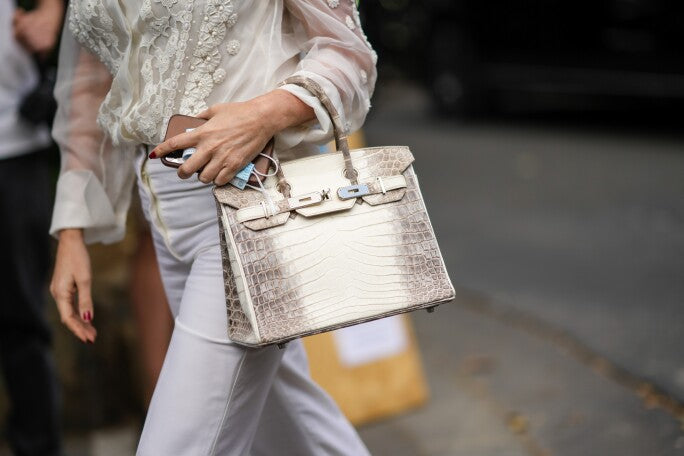
The Birkin is a structured trapezoid tote with a flat base, two rolled top handles, and a signature front flap secured by a twist-lock clasp — the iconic Hermès toggle closure — beneath which sits a lockable clasp with a small padlock and keys. The interior is spacious and unlined in the truest sense, allowing the full beauty of the leather to speak for itself.
Signature Details
- Trapezoid silhouette with flat base
- Rolled double top handles
- Front flap with toggle closure
- Padlock, keys and clochette
- Palladium or gold hardware (your choice)
- Single interior zip pocket
- Blind stamp indicating the year of manufacture and the artisan who made it
The Sizes
Here's the full sizes section, tightened up:
Sizes
The Birkin is produced in six sizes, each with a distinct personality and a different kind of practicality.
Birkin 20
The most petite and arguably the most covetable Birkin in the range right now. Rare, refined, and utterly singular — the 20 has captured the attention of collectors and fashion insiders alike. It is the Birkin for those who truly know.
Birkin 25
The most sought-after of the classic sizes. Neat, structured, and impossibly chic — it holds just the essentials and that is precisely its appeal. It also commands some of the strongest resale values in the entire range.
Birkin 30
The sweet spot. Historically the most popular size, the 30 offers a little more room without sacrificing an ounce of elegance. If you are buying your first Birkin, this is the size most people come back to.
Birkin 35
The original. The size Jane Birkin herself carried — typically overstuffed, slightly battered, and utterly iconic for it. Genuinely functional, beautifully relaxed, and particularly well suited to taller frames.
Birkin 40
A specialist choice. Roomy enough for a short trip, bold enough to make an entrance. Not for everyone — but for the right person, extraordinary.
Birkin 50 (HAC)
The Haut à Courroies — the bag that preceded the Birkin itself, originally designed to carry a saddle. The largest in the family and a true collector's piece.

Final Thoughts
The Birkin is many things — a triumph of craft, a symbol of a certain kind of ambition, a bag that has somehow managed to remain genuinely desirable across four decades and every shift in the cultural landscape. But more than any of that, it is an exceptionally well-made object that improves with age, holds its value in a way almost nothing else does, and brings a very particular kind of quiet pleasure every single time you carry it.
The only question worth asking is not whether the Birkin is worth it. It is. The question is simply which one is yours.


